

CBAM 2026: Estimate CBAM Certificate Costs and Understand Their Real Impact on Import Prices

During the transitional period, many businesses viewed the CBAM primarily as a reporting obligation, without direct financial consequences. This changed fundamentally at the beginning of 2026, when the mechanism entered its definitive operational phase.
CBAM therefore introduces a new dimension to assessing the commercial viability of imports. Alongside the purchase price, customs duties and logistics costs, businesses must now take account of the cost of CO₂ emissions—previously not subject to direct settlement in international trade.
How CBAM costs are calculated
Calculating the CBAM cost is not simply a matter of multiplying the level of emissions by the price of CBAM certificates. The number of certificates that must be purchased is determined by a more complex algorithm that takes account of both emissions and adjustment mechanisms linked to the EU ETS.
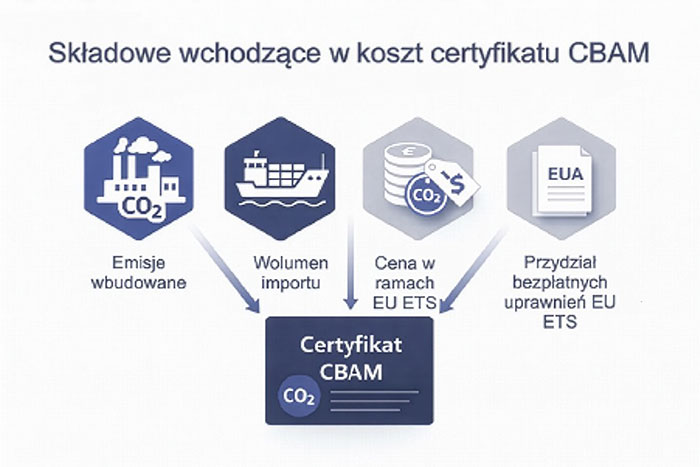
The cost of CBAM certificates is determined by four core elements:
- the level of embedded emissions in the product;
- the volume of imports;
- the price of CO₂ emission allowances in the EU ETS; and
- the level of free allocation of allowances under the EU ETS.
Embedded emissions
The basis for calculating CBAM is the determination of the embedded emissions in a given product, usually expressed in tonnes of CO₂ per unit of goods. Depending on the category of goods, the scope of emissions to be considered may vary.
In particular, for goods listed in Annex II to the CBAM Regulation, only direct emissions are taken into account. In other cases, both direct and indirect emissions—i.e. emissions related to electricity consumption—must be considered.
| Category of goods | Required scope of emissions |
| Aluminium | Direct emissions only |
| Cement | Both direct and indirect emissions |
| Electricity | Direct emissions only |
| Fertilisers | Both direct and indirect emissions |
| Hydrogen | Direct emissions only |
| Iron and steel | Direct emissions only |
A significant factor affecting the cost level is the choice between default values and actual emissions. In practice, this decision will, in most cases, have the greatest impact on the cost of CBAM certificates.
As a rule, using actual emissions is more advantageous because it provides a more accurate representation of the actual emissions level and often results in a lower figure than the default values. Default values are conservative in nature and include an additional uplift that increases the level of reported emissions.
At the same time, the decision to switch to actual emissions should be preceded by a cost-benefit analysis. Obtaining actual data from a supplier, preparing it properly and having it verified by an accredited verifier involve additional operating costs, which are often overlooked at the preliminary analysis stage.
In practice, this means that although actual emissions will generally reduce the number of CBAM certificates required, the overall economic effect may be less clear-cut in some cases—particularly where import volumes are low or the difference between default and actual emissions is relatively small.
Import volume
The second key component of the calculation is the volume of imports. For CBAM purposes, it should be taken into account in full for each CN code and country of origin. Current rules exempt importers whose total annual imports of goods covered by the mechanism do not exceed 50 net tonnes from CBAM obligations. However, this threshold is a qualifying threshold and does not affect the method of calculating the cost: once it is exceeded, CBAM obligations apply to the entire import volume.
Importantly, the volume used in the CBAM calculation should correspond to the quantities declared in customs declarations for the relevant CN code. This means that the data used for the calculation must be consistent with customs documentation and reflect the actual volume of goods released for free circulation in the European Union.
Free allocation of allowances
An important element affecting the level of CBAM costs is the mechanism associated with the free allocation of allowances under the EU ETS.
The CBAM calculation algorithm takes into account the CBAM factor and benchmark, which reflect the mechanisms in place under the EU ETS in the European Union. These components are already known and regulated by implementing acts issued under the CBAM Regulation.
It should be emphasised, however, that the impact of this mechanism will systematically decrease over the coming years. This follows from the timetable for the gradual phase-out of free allocation under the EU ETS.
In practice, this means that:
- the benchmark adjustment component will become progressively smaller;
- the number of certificates required will increase; and
- the total CBAM cost will rise over time.
The EU ETS emissions price
The final CBAM cost depends directly on the price of CO₂ emission allowances in the EU ETS, which forms the basis for valuing CBAM certificates.
A specific transitional mechanism applies in 2026. The price of CBAM certificates is determined as the quarterly average of EU ETS allowance prices for the period in which the import took place. These values are published by the European Commission after the end of each quarter, making it possible to attribute the cost to the relevant reporting period.
CBAM certificate price publication schedule for 2026
| Q1 2026 | Q2 2026 | Q3 2026 | Q4 2026 |
| 7 April 2026 | 6 July 2026 | 5 October 2026 | 4 January 2027 |
According to analyses published by KOBiZE, EU allowance prices in 2026 may range from approximately EUR 85 to EUR 100, corresponding to an average close to EUR 92. In practice, reference prices for CBAM certificates can already be tracked on the European Energy Exchange (EEX) platform, where current quotations are published.
From 2027, however, the CBAM certificate-purchase mechanism will operate under its full definitive model, with the price set weekly as the average EU ETS auction price. The purpose of this solution is to ensure economic consistency between the costs borne by EU producers and importers of goods covered by CBAM.
This represents a shift from a more static model to a dynamic one, in which the CBAM cost becomes directly linked to current market conditions. Volatility in EU ETS prices means that the CBAM cost is not fixed and will change as allowance prices move.
Emission allowance prices are also sensitive to economic and geopolitical factors, such as the economic cycle, energy-market conditions and regulatory decisions. As a result, CBAM costs may fluctuate materially over time, making ongoing monitoring and inclusion in financial analyses and purchasing decisions essential.
Illustration of CBAM costs
The following example illustrates the calculation. Assume a product from the iron and steel category under CN code 7306 40 80, imported from China in 2026, with an annual import volume of 100 tonnes. For this product, the default value for direct emissions is 7.717 tCO₂ per tonne, while the corresponding CBAM benchmark is 1.189 tCO₂. The CBAM factor for 2026 is 97.5%.
The calculation begins by accounting for the mechanism corresponding to the gradual phase-out of free allocation under the EU ETS. The emissions benchmark is multiplied by the CBAM factor, giving a value of 1.159275 tCO₂ per tonne of product. This value is then deducted from the embedded emissions to determine the emissions that are actually subject to settlement.
In the example, the difference is 6.557725 tCO₂ per tonne of product. When multiplied by the 100-tonne import volume, this results in 655.7725 CBAM certificates to be surrendered. Assuming a forecast certificate price of EUR 92, the total cost is therefore EUR 60,331.07.
The impact of CBAM on import prices and transaction profitability
The introduction of CBAM means that the cost of CO₂ emissions becomes a direct component of the price of an imported product. As a result, two goods with identical specifications may generate different total costs solely because of differences in their embedded emissions. This means that the purchase price is no longer the only measure of commercial viability; the emissions intensity of production also becomes material.
CBAM costs are variable and directly linked to EU ETS prices, which are influenced by economic and geopolitical factors. In practice, import costs must therefore be analysed across different price scenarios, as their level may change materially over time.
Over the longer term, the importance of CBAM as a cost component will grow. As free allocation under the EU ETS is reduced, the number of certificates to be surrendered will increase. This will lead to higher costs and may require businesses to adjust their pricing policies and procurement strategies.
Estimate the CBAM cost for your business
If you would like to make an initial assessment of the impact of CBAM on your business, please contact us.
After completing the form and providing:
- the CN code of the goods;
- their country of origin; and
- the annual import volume,
you will receive an indicative calculation of the CBAM emissions cost, prepared using current regulatory and market assumptions.
Questions? Contact: Łukasz Pamuła – lukasz.pamula@thedy.pl